Seven years ago, I was a mother who was irritated by her own children.
Not in a quiet, private way. In a real way. Their clinginess wore me down. Their tantrums made my chest tight. The constant need, the constant noise, the constant more, more, more from small people who did not know how to ask for anything gently. I loved them with everything in me. And I was also, most days, exhausted by them.
I told myself the problem was outside of me. It was their behavior. Their age. Their personalities. If they would just calm down, listen the first time, stop pushing every single boundary, I would be the calm mother I knew I could be.
Then a friend who was studying psychology asked me one question.
She did not ask about my kids. She asked about me.
When they are clingy, what happens in you?
I did not have an answer. Not a real one. I had never once turned the lens around. And that one question, simple as it sounds, changed everything.
The Realization Nobody Warns You About
Here is what I found when I finally looked inward, instead of outward.
I could not handle my own emotions. I had never learned how.
Not because I was weak. Because nobody taught me. I grew up the way most of us did, where big feelings were something to manage quietly, not something to understand. So I became an adult who was very good at functioning and very bad at feeling. And then I became a mother, which is the most feeling job there is, and I had no tools for it at all.
My children were not causing my reactions. They were triggering them. Their tantrum was not the problem. It was lighting up something old in me, some leftover wiring from my own childhood, some belief that I was not allowed to fall apart, that needing too much was shameful, that calm was something other people got to have.
When my son cried for the fifth time in an hour, it was not really the fifth cry that broke me. It was every unprocessed feeling I had stacked up underneath it, finally finding a crack to come through.
Why Conscious Parenting Has to Start With You
This is the part most parenting advice skips.
We get told to be patient. To get on their level. To use a calm voice, validate their feelings, offer choices instead of commands. All of this is good advice. None of it works for long if the adult giving it is running on an empty, unhealed nervous system.
You cannot regulate a child’s emotions while your own are unregulated. You can perform calm for a while. You can grit your teeth and use the gentle voice. But your nafs, the inner self, knows the difference between calm and controlled. And so does your child. Children read the body before they read the words. They will trust your energy over your sentence every single time.
This is why conscious parenting is not a parenting technique. It is an inside job first. It asks you to look at your qalb, your heart, and get honest about what is actually happening there when your child pushes a button you did not know you had.
I had to stop asking, “how do I get my child to behave?” and start asking, “what is happening in me when they do not?”
That question changed the entire trajectory of how I raise my children.
What Changed When I Did the Work
I started therapy. For the first time, I had a space to say the things I had never said out loud, things about my own childhood, my own unmet needs, my own fear of not being enough.
After about a year, I began studying life coaching. Then EFT. Then I trained for my PCC through the ICF. Then NLP. Then team coaching. Each step gave me another tool for the same project: learning to feel my feelings instead of managing them away.
And slowly, my home changed. Not because my children stopped having tantrums. Children have tantrums. That is not a malfunction; that is childhood. What changed was me. I stopped taking their big feelings as a personal attack. I stopped needing them to be calm in order for me to feel calm. I learned to stay steady while they were not, which is the actual definition of holding space, something I used to read about and not understand.
I now homeschool my three children. Six years and counting. I see it as proof of how far the healing carried me, because the woman who was once undone by a clingy toddler could not have imagined choosing to spend all day, every day, with her kids by choice.
The Shift: From Managing Behavior to Healing Yourself
If you take one thing from this, let it be this reframe.
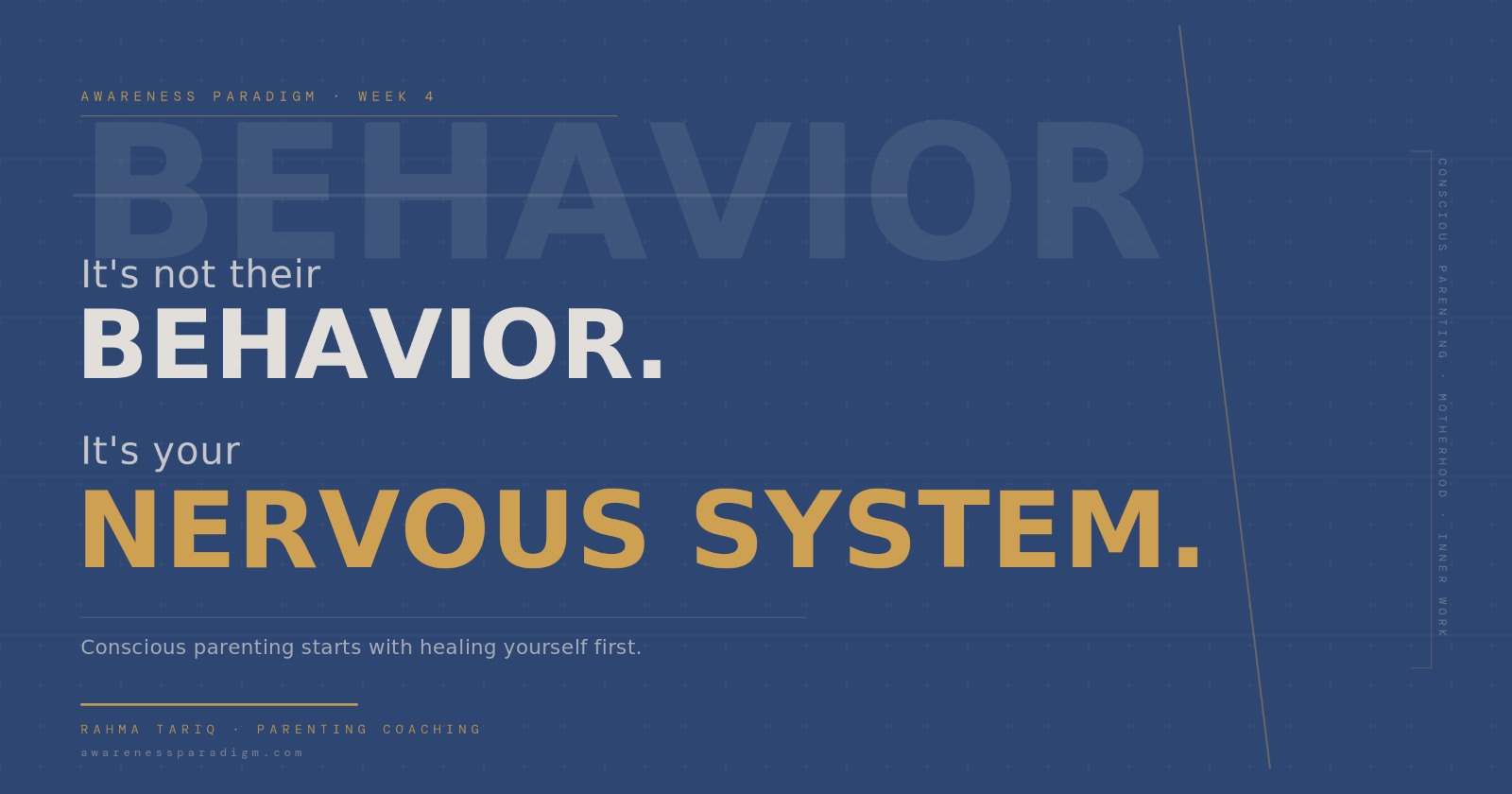
Conscious parenting is not a set of better responses to bad behavior. It is the slow work of becoming a person whose nervous system is not hijacked by a four-year-old’s meltdown. It is recognizing that the trigger in you is older than the child standing in front of you, and it deserves its own attention, separate from whatever they did to set it off.
Allah does not change the condition of a people until they change what is within themselves. The same is true inside your own home. Your household will not become calmer because you found new rules. It becomes calmer because you became someone whose calm does not depend on everyone else behaving.
Five Places to Start
- Notice the trigger before the reaction. The next time your child does something that makes your chest tighten, pause for one second before you respond. Ask yourself: is this really about right now, or did something old just get touched?
- Name what is happening in you. “I am feeling really overwhelmed right now” said to yourself, or even to your child, does more good than a forced calm voice covering a storm underneath.
- Separate your worth from their behavior. A meltdown is not a verdict on your parenting. It is a four-year-old or a fourteen-year-old without the tools yet to handle a big feeling. That is their job to grow into, not your failure.
- Build a regulation practice that is not about your kids. Whether that is dhikr, breathing, a short walk, or five minutes of stillness before the school run, you need a way to return to yourself that has nothing to do with whether anyone else is being calm.
- Get support if you need it. Therapy, coaching, or a community of mothers doing the same inner work can help. You were not taught to feel your feelings. There is no shame in learning it now, with help, instead of alone.
You Are Not Failing. You Are Just Doing What Nobody Taught You
If you are reading this and recognizing yourself in it, the irritation, the guilt that follows it, the feeling that you should be calmer than you are, I want you to hear this clearly.
You are not a bad mother. You are a mother who was never given the tools, doing her best with an emotional toolkit that was never built for this job. That can change. It changed for me, slowly, through real work, not through trying harder to be patient.
Your children do not need a perfect mother. They need a mother who is doing the work to come home to herself, again and again, especially on the hard days.