From the outside, my life looked exactly the way it was supposed to.
A loving husband. Two beautiful children. A home filled with noise and laughter and the small, ordinary chaos that means everything is okay. And everything was okay. That is what I told everyone. That is what I told myself.
Until my skin started telling a different story.
It began without warning. Red, angry patches appearing on my body, itching, burning, refusing to fade. I did what any responsible woman does. I went to the doctor. Then I went again. And again.
Steroids. Antihistamines. Prescription creams. Allergy tests. Blood work. More doctors. More waiting rooms. More hopeful treatments that worked for a week and then quietly stopped working, the way hope does when you have leaned on it too many times.
Week after week, I sat in clinics and hospitals, watching doctors look at my skin with furrowed brows and uncertain eyes. Every test came back inconclusive. Every treatment eventually failed.
We do not know what is causing this.
Those words, repeated so many times, began to feel like a verdict. Not just about my skin, but about me. As if my own body had become a mystery even to the people trained to read it.
The Pattern
I started tracking everything. What I ate. What I used on my skin. The weather, the season, the laundry detergent, the fabric of my clothes. I made lists. I cut things out. I reintroduced them one at a time like a scientist running out of theories.
Nothing matched up. The rashes did not care about my diet. They did not care about the season. There was no allergen, no fabric, no food that lined up with the flare-ups in any way I could prove.
And then one quiet evening, the kind of evening where the children are finally asleep and the house settles into stillness, I noticed something that no doctor had ever asked me about.
The rashes did not follow food. They did not follow seasons.
They followed stress.
I went back through my memory like turning pages in a book. The flare-up the week of that difficult conversation I never finished. The outbreak three days after I smiled and said, “it is fine,” when it was not fine at all. The rash that appeared on my chest, right over my heart, after a moment that hurt me so deeply I told no one. Not even myself.
My body had been keeping records.
Every unspoken word. Every swallowed hurt. Every time I performed “okay” when something inside me was breaking.
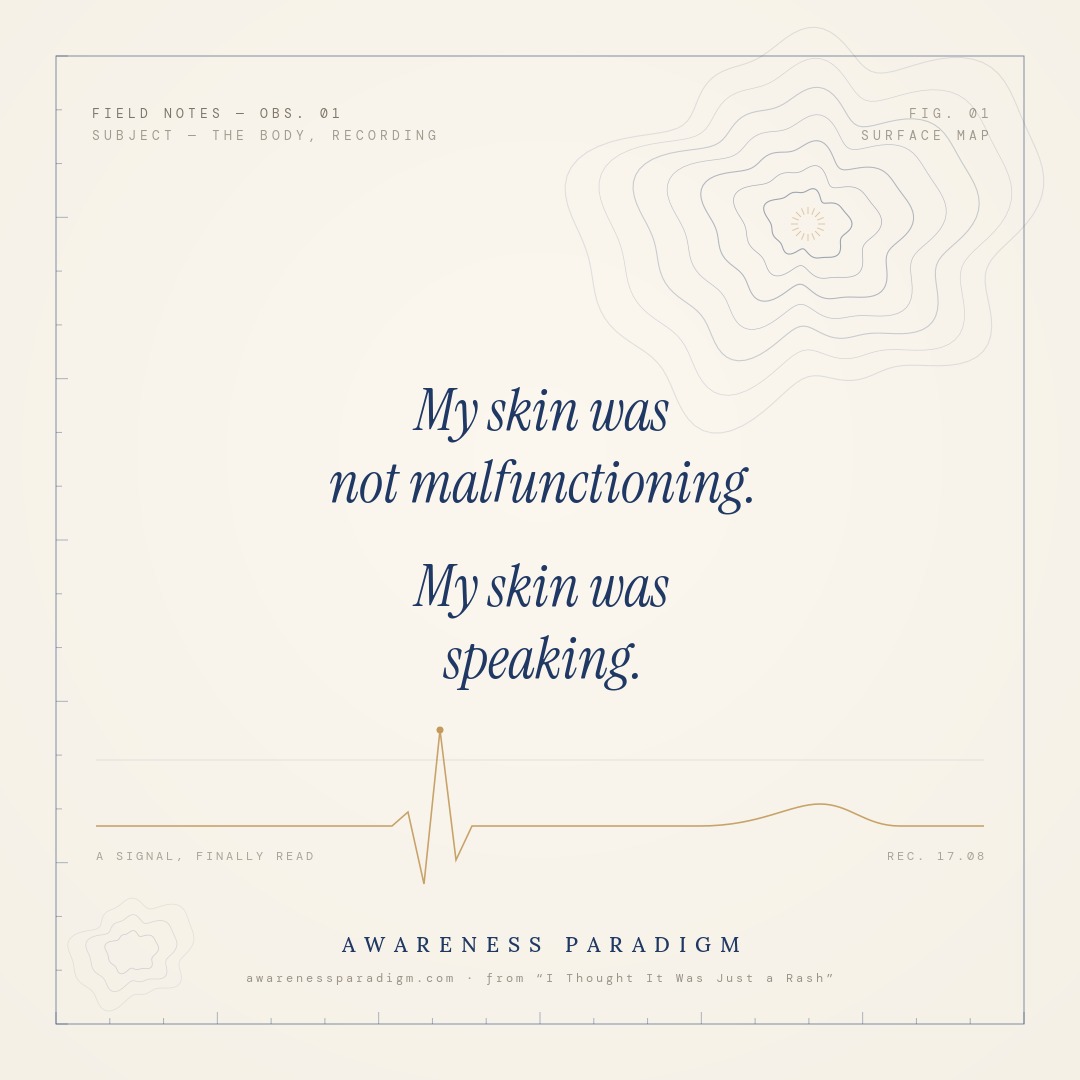
My skin was not malfunctioning. My skin was speaking.
I remember sitting with that realization, really sitting with it, and feeling two things at once. Relief, finally, an answer. And grief: how long had I been carrying this without knowing?
What I Did Not Know Yet About Emotional Suppression
At the time, I did not have a name for what was happening to me. I know now that this is what emotional suppression looks like from the inside. It rarely feels dramatic. It feels like being “fine.” It feels like being the strong one, the calm one, the one everyone else leans on. It feels responsible.
What it actually is, is a quiet agreement you make with yourself, over and over, for years, to push feelings down because there is no time, no space, and no permission to feel them.
And the body keeps the bill.
For some people it shows up as headaches. For others, it is exhaustion that no amount of sleep touches, or tightness in the chest, or a stomach that is always slightly unwell. For me, it was my skin, the most visible part of me, ironically, becoming the place where my most invisible feelings finally surfaced.
I had spent years treating the symptom. I had never once been asked about the story underneath it.
Then, Therapy
When the rashes finally slowed, not from medication, but from the moment I started truly listening to myself, I made a decision. I went to therapy.
And for the first time in a long time, I sat in a room where someone asked me not about my skin, but about me. What I was carrying. What I had never said out loud. What my body had been trying to communicate for years while I kept handing it creams and antihistamines instead of attention.
It was uncomfortable. It was humbling. There were sessions where I cried over things I did not even know I was still holding: a comment from years ago, a role I had played in my family since childhood, a version of myself I had buried so I could keep everyone else comfortable.
It was also, quietly and slowly, the most healing thing I had ever done.
Therapy gave me a language for what I had been living without words. I learned that emotional healing is not a single moment where everything resolves. It is closer to learning a new way of living: noticing a feeling instead of swallowing it, naming a need instead of brushing past it, letting a hard conversation be hard instead of rushing to make it “fine” again.
And somewhere in the middle of that process, sitting with my own wounds, learning to name them, watching them slowly lose their grip on me, something shifted.
This Is Not Just My Story
I would sit in sessions and recognize patterns I had seen in the women around me. Sisters. Friends. Women in my community who smiled too quickly and cried too rarely. Women whose bodies were also speaking in rashes, headaches, exhaustion that sleep could not fix, and a tiredness that had nothing to do with how much they slept.
Women who had been told by culture, family, and their own inner voice that their pain was not important enough to examine. That there were always other people whose needs came first. That to feel deeply was to be “too much,” and that the safest thing to do with a feeling was to fold it up small and carry on.
I realized that what I had learned through my own healing was not meant to stay with me. It was meant to be passed on.
So I trained. I studied. I became certified as a Mindset and Emotional Wellness Coach, not despite what I had been through, but because of it.
What Your Body Might Already Be Telling You
If you are reading this and something in it feels familiar, a symptom that will not resolve, a tiredness that does not make sense, a tension that shows up at the same time every week, I want to gently say this: it might be worth listening, not just treating.
This is not about ignoring medical advice. I saw doctors for years, and that was the right thing to do. It is about adding a question that often gets left out: what else might my body be carrying right now?
- Keep a simple log. Track symptoms, but also what was happening emotionally in the days before: a hard conversation, a disappointment, or a moment you kept it together when you wanted to fall apart.
- Notice your “I am fine” moments. How often do you say it when it is not quite true? Each one is a small act of emotional suppression, understandable in the moment, but worth noticing.
- Give feelings five minutes. You do not need to process everything immediately. Give yourself five honest minutes in the car, in the shower, or before bed to feel what you actually felt that day.
- Consider talking to someone. A therapist, a coach, or a trusted friend who will not rush to reassure you out of your feelings. Sometimes healing starts simply by being witnessed.
The Shift That Changed Everything
I do not share this story for sympathy. I share it because I know I am not the only woman who has sat in waiting rooms with answers that never came, while the real answer was quietly written across her skin, her sleep, her energy, her mood.
Emotional healing did not make my life perfect. It made it honest. It gave me back a relationship with my own body, one built on listening instead of managing, on curiosity instead of frustration.
If there is one thing I want you to take from this, it is this: your emotions are not your enemy, even when they show up in inconvenient, uncomfortable, or physical ways. They are information. And they deserve to be heard before they have to shout.