Every January, I watch it happen.
Someone decides this is the year. They write the goal. They mean it. They really, truly mean it this time.
And for a few weeks, they are on fire.
Then something happens. Life gets busy, or hard, or just ordinary. And the goal quietly disappears. Not with a dramatic decision to quit. Just a slow fade until one day it is gone, and they are back where they started, feeling worse than before, now with a fresh layer of evidence that they cannot follow through.
And the conclusion they reach?
I just do not have the motivation.
I hear this constantly. From mothers, from professionals, from women who are brilliant and capable and have every reason to believe in themselves, but do not. Not really. Not underneath.
And I need to tell you something that changed the way I understand this, because it changed the way I understood myself.
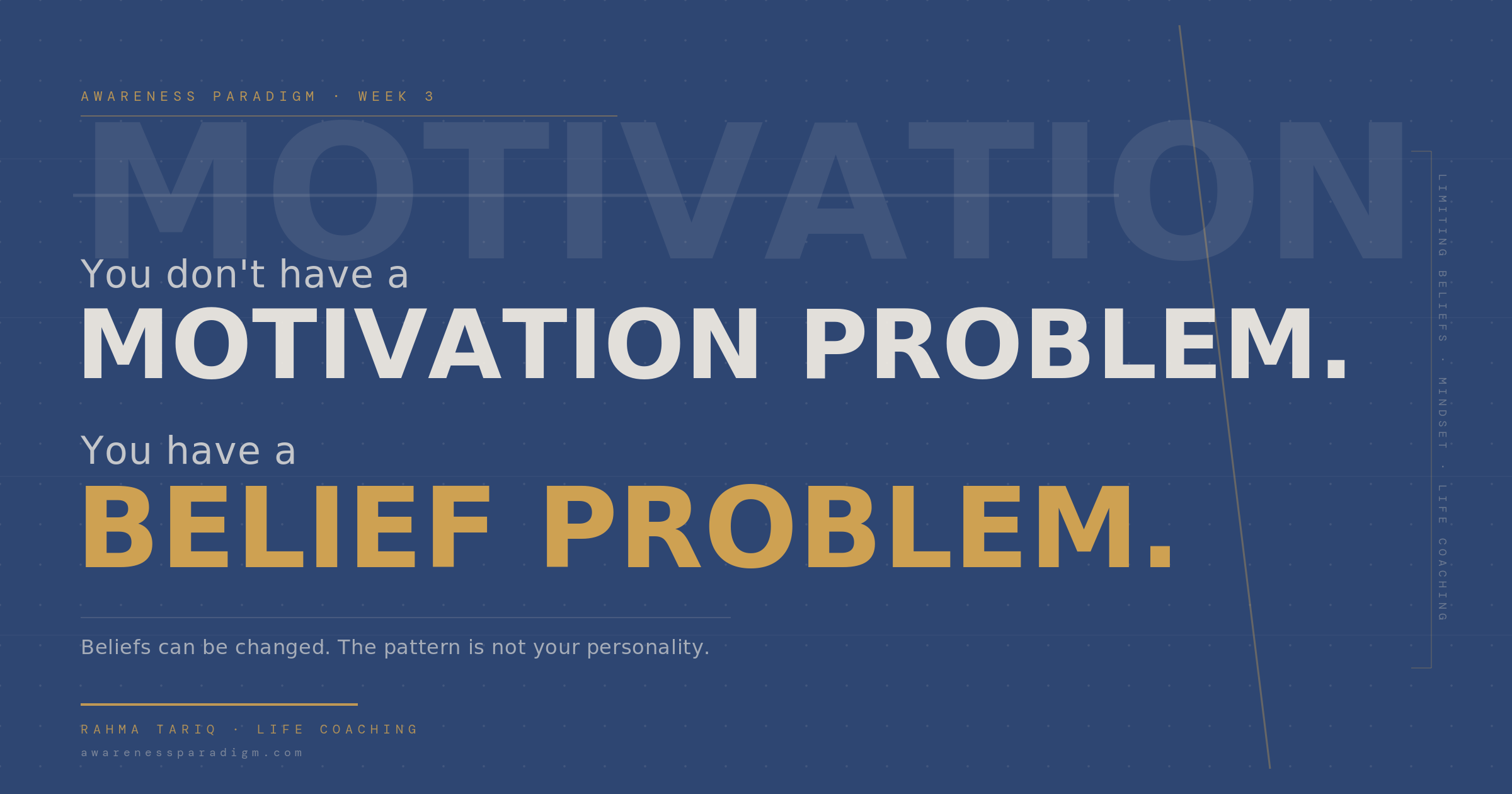
Motivation is not your problem. Belief is.
The Story We Tell About Ourselves
Here is what actually happens when someone stops.
It is not that the goal stopped mattering. It still matters. It probably matters a lot. What changes is a thought, one small, almost invisible thought, that sneaks in somewhere between the goal and the doing.
This probably will not work for me.
I have tried before and it did not last.
I am just not a disciplined person.
Other people can do this. I am not sure I can.
These thoughts do not announce themselves. They do not arrive with a warning label. They feel like observations. Like honest assessments of your track record. Like facts.
They are not facts.
They are beliefs. Old ones. Often ones you formed years ago, from small moments you probably do not even remember consciously: a comment, a failure, a comparison, a role you were assigned in your family. Beliefs that were made for a younger version of you, in a different set of circumstances, by a mind that was just trying to protect you.
And now, years later, they are still running.
They run so quietly that you have mistaken them for your personality. You have called yourself not a finisher, easily distracted, not driven enough. You have explained yourself using these beliefs so many times that you have stopped questioning whether they are actually true.
What Motivation Actually Is
People treat motivation like it is a fuel tank. Either you have it or you do not. If you have it, you go. If you do not, you sit still.
But this is not how it works.
Motivation is not something that arrives first and then action follows. It works the other way. You take a small action. The action builds a little evidence. The evidence nudges a belief. The belief creates a feeling. And that feeling, I can do this, I have been doing it, is what most people are calling motivation.
So when the motivation is missing, what is actually missing is the belief that the action is worth taking. That you are worth the effort. That it will be different this time.
You cannot find motivation by waiting for it. You cannot will it into existence. But you can look at the belief underneath it and ask: is this actually true? Or is this just a story I have been telling for so long that I forgot it was a story?
Where Limiting Beliefs Come From
I want to be clear here: your beliefs about yourself were not random. They were learned.
Children absorb everything. A parent who said, “you never finish what you start,” maybe once, maybe dozens of times, planted something. A classroom where you tried and it did not go the way you hoped planted something. A season of your life where everything felt hard planted something.
None of this is about blame. The adults around you were carrying their own unexamined beliefs. They taught you what they themselves had been taught.
But understanding where beliefs come from is important because it reveals something: if they were learned, they can be unlearned. They are not hardwired into you. They are not your identity. They are patterns, old patterns, strong patterns, but patterns nonetheless.
Indeed, Allah will not change the condition of a people until they change what is within themselves. (Ar-Ra’d: 11)
I find this verse quietly radical. It does not say conditions will change when the world around us changes. It says the change begins within. The nafs, the inner self, is where transformation actually lives. And this is not a spiritual metaphor. It is a description of how real psychological change works.
Until you change the belief, the behavior will keep reverting. Not because you are weak. Because beliefs are powerful.
The Shift: From Why Can’t I? to What Do I Believe?
When a client comes to me saying they have no motivation, the first thing I do is slow down the story.
I do not try to help them find more motivation. I ask them to tell me about the last time they stopped.
And we look at what was happening right before. Not the external circumstances, though those matter, but the thoughts. What was the running commentary? What did they tell themselves, quietly, in the moment they pulled back?
I did not deserve this anyway.
This is too hard, which means I am not cut out for it.
Other people can, but I have seen my own pattern. I know how this ends.
When the belief becomes visible, something shifts. Because a belief you can see is a belief you can question.
And a belief you can question is one you can change.
Three Practical Ways to Begin
- Catch the commentary. The next time you pull back from something that matters to you, pause before you decide you are lazy. Ask: what did I just think, in the moment before I stopped? Write it down, even one sentence. You are looking for the belief underneath the behavior.
- Question the verdict. Take the belief and ask it three questions: When did I first think this about myself? Is there any evidence this is not always true? Who would I be if I did not believe this? You do not need perfect answers. You need the questions to crack the certainty.
- Start smaller than you think. If a belief says, “I never follow through,” you cannot fight it with a massive goal. Fight it with a five-minute action you can actually finish. Every small follow-through builds evidence that the belief is wrong. Evidence is the only thing that quietly moves a belief over time.
Why This Matters More Than You Think
I spent years thinking I was not motivated enough. That I was too scattered, too sensitive, too easily overwhelmed.
What I was, was carrying beliefs about myself that had never been examined. Beliefs that said I could not handle hard things. That I had been built for a smaller life. That the version of me who was calm and focused and disciplined was someone I could admire in others but never quite be.
Therapy helped me see them. Coaching helped me question them. And the slow, patient work of changing those beliefs, not in a moment, but over months of small evidence building on small evidence, changed everything about how I move through my life.
I am still the same person. But I am no longer held in place by a story that was never actually mine.
You Are Not the Belief
If you have spent years telling yourself you are unmotivated, or undisciplined, or easily distracted, or someone who always quits, I want to say this as clearly as I can:
That is a story. Not a fact.
The goal you keep circling back to, year after year, the one that keeps reappearing no matter how many times you shelve it, is trying to tell you something. It is still there because some part of you believes it is possible. Even if another part is throwing up every objection it can find.
The work is not to find more motivation.
The work is to find the belief that is standing between you and the life you already know, somewhere underneath everything, is available to you.