When I first told someone I was doing EFT tapping, they laughed.
Not unkindly. Just that small, polite laugh that means: that sounds a little strange.
I understood it. I'd had the same reaction when I first heard about it. Tapping on your face? On your collarbone? To help with anxiety?
It sounded like something between acupuncture and wishful thinking.
But here's what happened. I tried it. And then I noticed things changing, quietly, in ways I hadn't expected. My nervous system felt calmer after a session. Old emotional memories lost some of their charge. I started sleeping better. I started responding instead of reacting.
So I went looking for the science. Because I'm not someone who can just do something without understanding why it works. And what I found changed how I talk about EFT entirely.
It doesn't work because it's magical. It works because of what it does to your brain.
What EFT Actually Is
EFT stands for Emotional Freedom Techniques. It's a therapeutic approach that combines two things: the ancient Chinese understanding of energy meridians, and modern psychology's understanding of how trauma and emotion live in the body.
In a session, you tap gently with your fingertips on specific points on your face and upper body, while speaking out loud about what you're feeling. The tapping points correspond to meridian endpoints used in acupuncture. The spoken element comes from cognitive and exposure therapy.
Together, they do something that neither alone does quite as well.
The Brain Science: What Happens When You Tap
This is the part that made everything click for me.
When you're anxious, in pain, or emotionally triggered, a small almond-shaped structure in your brain called the amygdala fires up. The amygdala is your threat detector. It's ancient. It doesn't understand the difference between a charging lion and an argument with your mother. It reads "danger" and floods your body with cortisol, the stress hormone, to help you survive.
This is useful when the danger is real. It becomes a problem when it fires dozens of times a day over things that aren't actually threatening your life.
What EFT does is send a calming signal directly to the amygdala.
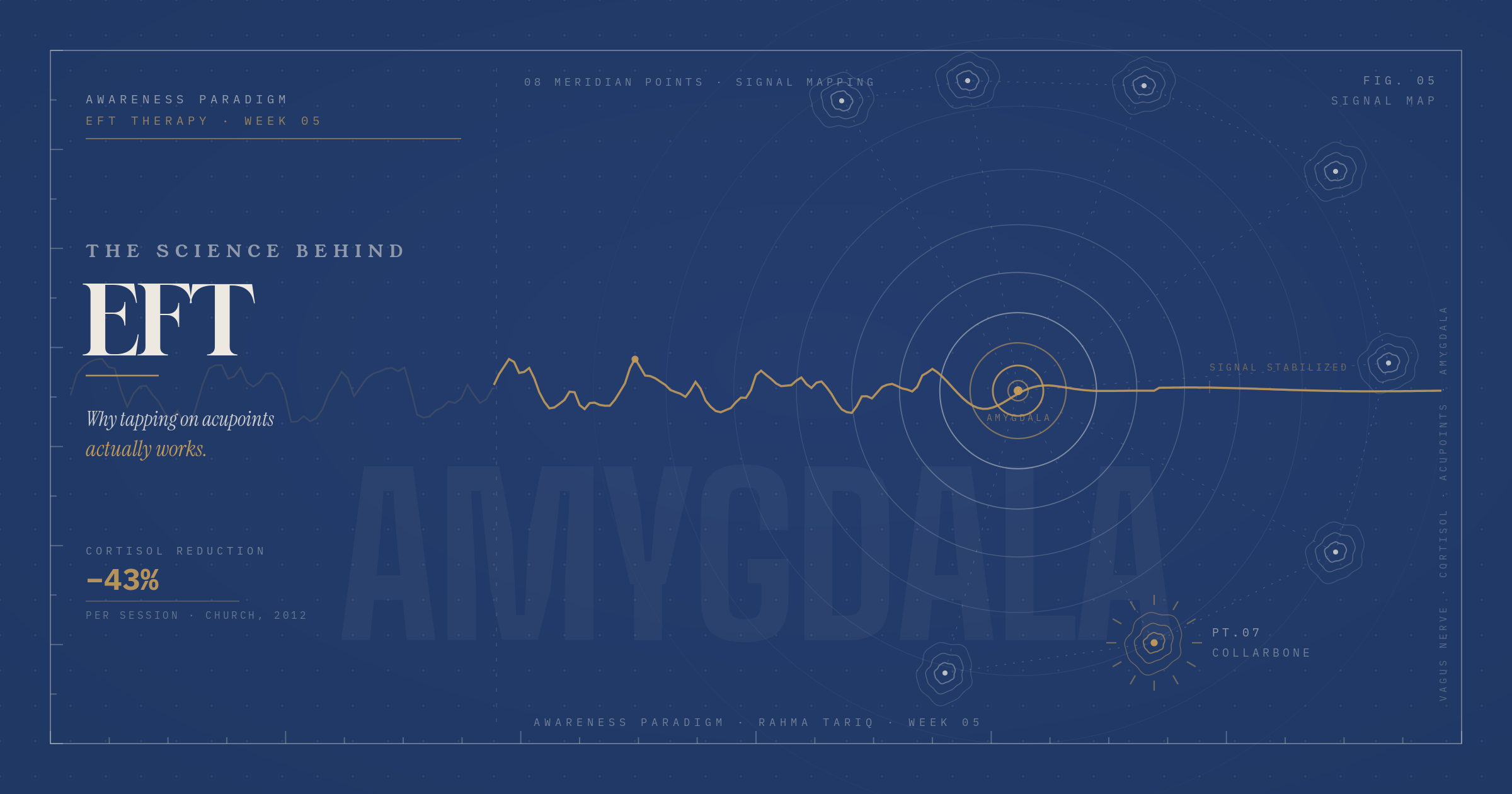
Research by Dr. Dawson Church and his team showed that EFT tapping can reduce cortisol levels by an average of 43% in a single session. That's significant. Nothing about that is placebo. Cortisol is measurable. The change is physiological.
When you tap on the meridian endpoints while focusing on an emotional issue, you're essentially sending a safety signal to your nervous system at the same time you're processing a threat. Your brain receives two things simultaneously: the thought or memory that's causing distress, and the physical message that your body is safe right now. Over time, this pairing changes how the brain files that memory. The emotional charge begins to reduce.
This is called extinction learning. It's the same mechanism used in exposure therapy. EFT just works faster, because the tapping accelerates the signal.
The Research That Surprised Me
I wasn't expecting the evidence base to be as strong as it is.
A meta-analysis published in the Journal of Nervous and Mental Disease looked at 14 randomized controlled trials on EFT for anxiety. The results showed a large effect size, larger than many conventional treatments. Another study found that EFT reduced PTSD symptoms in veterans, with 86% of participants no longer meeting the clinical criteria for PTSD after six sessions.
Six sessions.
Research has also shown EFT to be effective for depression, phobias, chronic pain, and even food cravings. A study from Griffith University in Australia found that people who did EFT tapping before meals consumed significantly fewer calories and reported reduced cravings, because the tapping reduced the anxiety and emotional drive behind the craving.
It works across a wide range of issues because it targets the same root thing in all of them: a nervous system that has learned to stay on high alert.
Why Acupoints Specifically
This is the part that bridges the ancient and the modern.
The meridian points used in EFT are the same endpoints used in acupuncture for thousands of years. Traditional Chinese medicine understood that energy moves through the body along specific pathways, and that disrupting or unblocking those pathways affects health.
Modern neuroscience has found that the areas targeted by these points are rich in nerve endings that connect directly to the vagus nerve, which is the primary channel through which the brain communicates with the body. Stimulating these points sends signals through the nervous system faster than cognitive thought alone can.
This is why talking about something difficult doesn't always make it better. You can understand why you're anxious and still feel anxious. The mind knows, but the body hasn't received the message yet.
Tapping speaks to the body directly.
In the Quran, Allah says: "Verily, in the remembrance of Allah do hearts find rest." (Ar-Ra'd: 28)
I've thought about this verse a lot in relation to EFT. There is something about coming back to the body, to breath, to deliberate presence, that mirrors what dhikr does at a spiritual level. Both are about interrupting the noise. Both are about returning something to stillness. The science is catching up to what was always true: that healing lives in the body as much as it lives in the mind.
What a Session Does to Your Nervous System
Let me walk you through what's actually happening during an EFT session, physiologically.
You begin by identifying the issue. Fear. Anger. A specific memory. A physical sensation. You rate how intense it feels on a scale of one to ten.
You tap on the karate chop point on the side of your hand while saying a setup phrase: "Even though I feel this anxiety, I deeply and completely accept myself."
Then you move through the sequence: eyebrow, side of eye, under eye, under nose, chin, collarbone, underarm, top of head. Tapping gently, about seven times at each point, while continuing to speak about what you're feeling.
During this process, your heart rate begins to slow. Your cortisol begins to drop. Your amygdala receives calming signals through the tapping. Your prefrontal cortex, the thinking part of your brain, can re-engage because the alarm has been turned down enough to think clearly.
After several rounds, most people notice the intensity of the feeling has reduced. Sometimes dramatically. Sometimes within minutes.
What would have taken weeks of rumination to process can sometimes move in a single session.
This Is Not About Bypassing Your Emotions
I want to be clear about this, because I think it's important.
EFT is not about making feelings go away. It's not about tapping anxiety into silence so you can get back to performing. That's not healing. That's suppression with extra steps.
What EFT does is reduce the charge around an emotion so you can actually feel it, rather than be overwhelmed by it. There's a difference between processing a feeling and being consumed by it. EFT creates the conditions where processing becomes possible.
The goal is not to feel nothing. The goal is to be able to feel everything without it swallowing you.
This is what I work toward with every client. Not numbness. Capacity. The ability to have a hard feeling move through you instead of getting lodged in you and staying.
Who It Works For
EFT isn't a niche tool. I've used it with women dealing with anxiety, with people carrying grief that never fully processed, with mothers whose parenting triggers were rooted in their own childhood pain, with professionals whose performance anxiety was affecting their work.
It works wherever there's an emotional charge that hasn't been fully discharged.
Which is, in my experience, most of us.
We carry things. Old things. Things we were told not to feel. Things we felt and had no one to feel them with. Things that happened once and got filed as "this is dangerous" in a nervous system that's been running that file ever since.
EFT is one of the most direct tools I've found for updating those old files.
What It's Like to Work With Me
When I do EFT with a client, I'm not following a script. I'm listening for the specific language you use, the exact sensation you feel in your body, the precise memory or belief that's underneath the surface issue. We find it together, and we tap on it together.
People often come in expecting to feel awkward. They leave surprised by how natural it felt, and how much lighter they are afterward.
One client told me after her first session: "I feel like I put down something I didn't know I was still carrying."
That's it. That's the point.
If you'd like to try EFT tapping and experience this for yourself, I'd love to work with you. You can book a session with me here.