
I was once in a meeting where everyone agreed with everything.
Every idea. Every plan. Every decision. Nods all around, no friction, no questions, no pushback.
And the leader left that room feeling great. Confident the team was aligned. Grateful for how smooth things were running.
What they didn't know was what happened in the corridor afterward.
Complaints. Concerns that had been sitting in people's chests for months, finally let out in low voices between people who felt safe with each other but not in that room. People who had opinions, doubts, better ideas, but had long since learned that the room didn't really want to hear them.
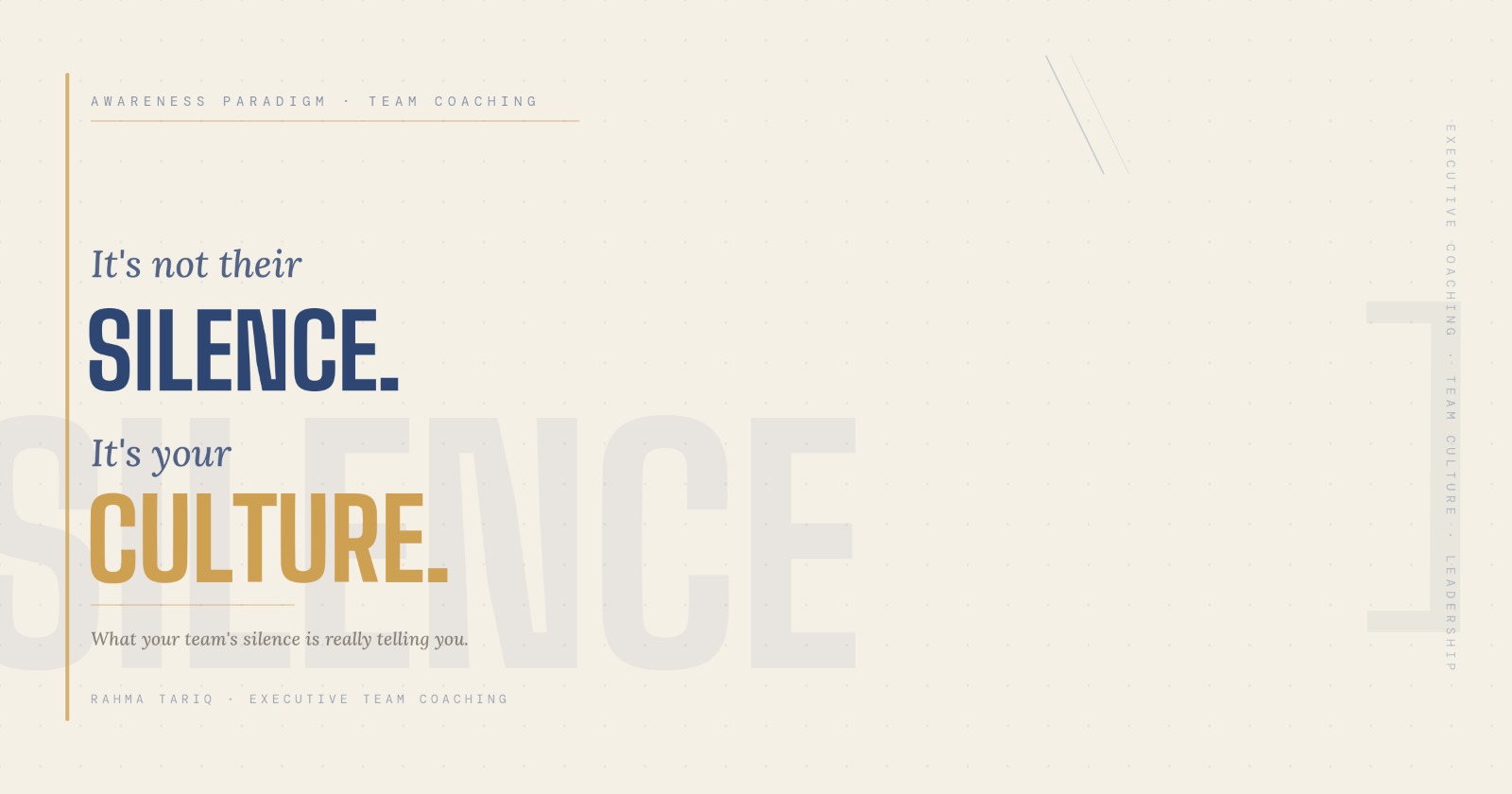
The silence in that meeting wasn't agreement.
It was a team that had stopped trusting it was safe to speak.
When "Everything Is Fine" Is the Problem
Here is something I've learned working with corporate teams. The most dangerous teams are not the ones where conflict is visible. The most dangerous teams are the ones where everything always looks fine.
Where no one challenges. Where disagreements are smoothed over before they reach the surface. Where people are professional, polite, cooperative, and completely disengaged underneath all of it.
In those environments, problems don't disappear. They go underground. They live in the things people say after the meeting, not during it. In the resignation letters that feel like they came out of nowhere. In the projects that stall because no one surfaced the risk they all privately saw coming.
By the time a leader notices something is wrong, the team has been quietly wrong for a long time.
Why This Happens in High-Performing Teams
Here is the part that surprises most leaders when we talk about it.
The teams most likely to become silent are often the most successful ones.
Not because success breeds complacency. But because high-performance cultures often communicate, without ever saying it directly, that certain emotions are not welcome. That uncertainty is weakness. That disagreement is disloyalty. That asking for help is falling behind.
These messages don't come from policies. They come from the leader's own patterns.
A leader who visibly dislikes being challenged will build a team that stops challenging. A leader who pushes through exhaustion and expects the same will build a team that hides its limits. A leader who goes quiet when things are tense will build a team that does not know how to handle tension directly.
The team reflects the leader.
Not because people are passive or impressionable. But because human beings are wired to read the emotional environment and adapt to it. We are social creatures. We attune to what is safe, and we avoid what is not. In a workplace, the leader sets that emotional temperature, whether they intend to or not.
This is what I mean when I tell leaders: your team's behaviour is data about you, not just about them.
What the Research Actually Says
Psychological safety, the belief that you will not be punished or humiliated for speaking up, is the single strongest predictor of team performance identified in Google's landmark Project Aristotle study. Not talent. Not strategy. Not technical skill. The feeling that it is safe to take risks with your words and ideas.
Teams with high psychological safety make fewer errors, report problems faster, innovate more, and retain their best people longer.
Teams without it perform adequately, until they don't.
The gap between those two realities often comes down to one thing: whether the person at the top of the team has done enough of their own emotional work to create a room where honesty feels possible.
What the Inner Work of Leadership Actually Looks Like
This is where most leadership development stops short.
It focuses on skills. Communication frameworks. Delegation strategies. Performance metrics. These are useful. But they sit on top of something deeper that, if not addressed, will limit all of them.
The patterns a leader brings into a room, how they handle criticism, how they respond to bad news, whether they can tolerate ambiguity, how they behave when they're stressed, these patterns shape the team's emotional culture more than any training ever will.
A leader who shuts down under pressure teaches the team that pressure is not survivable.
A leader who cannot receive feedback teaches the team that feedback is not safe.
A leader who performs confidence while privately carrying doubt teaches the team that the gap between the outer and inner self is just something everyone has to manage alone.
In the Quran, Allah reminds us: "He knows what is within the hearts." (Al-Mulk: 13) What is inside always finds its way out. The heart does not stay hidden for long. In leadership, this is not a spiritual observation. It is a practical one. The emotional state of the person at the front of the room has a direct, measurable effect on every person behind them.
What Changes When the Leader Changes
I want to be specific about what I mean by inner work for leaders, because it is not what most people imagine.
It is not about being more vulnerable in all directions or sharing personal history in professional settings. It is not therapy in the boardroom.
It is about being honest with yourself about what is activated in you when things get hard.
What happens in you when someone challenges your idea in front of the team? When a project fails? When someone on your team outperforms you? When a conversation doesn't go the way you planned?
Those moments of internal reaction, before you say or do anything, are where leadership is actually happening. And if those moments are running on old patterns, on fear of looking incompetent, on the need to be the smartest person in the room, on anxiety that was there long before this job, they will shape everything that follows.
When a leader does this work, the team changes. Not because the leader announces anything. But because the room changes. The temperature changes. People begin to sense that honesty is possible. That mistakes can be said out loud. That the leader can handle the truth.
And from that one shift, things that felt stuck for years begin to move.
For Leaders Who Recognise This
- Ask, and actually listen to the answer. Ask your team what is hard about working here. Not in a survey. In a real conversation. Then sit with what they say without defending yourself. What you hear will be uncomfortable. It will also be the most useful data you have received in a long time.
- Notice your patterns in hard moments. The next time a meeting goes off-script, or someone pushes back on you, or a project hits a wall, pause before you respond. What is happening in you? That internal state is what your team is reading. Before you manage them, manage that.
- Model the vulnerability you want to see. You cannot ask your team to be honest if you are not. Saying "I got that wrong" or "I don't have the answer yet" or "I've been carrying something about this project that I haven't named" costs you very little and builds more credibility than any polished performance of certainty.
- Make it safe to disagree with you specifically. Not in general. Not in theory. With you. The test of psychological safety is whether the most junior person in your team feels free to say something you might not want to hear, directly to you, in a meeting.
- Invest in the relational layer, not just the operational one. Team coaching is not team-building. It is the slower, more honest work of looking at what is actually happening between people, and addressing it. The skills, strategies, and systems matter. But they run on a relational substrate that either supports them or quietly undermines them.
Your Team Is Ready for More Than You Think
Here is what I want to leave you with.
The teams I have worked with that felt the most stuck, the quietest, the most politely dysfunctional, were not stuck because of bad people or impossible circumstances. They were stuck because nobody had created the conditions for the truth to be said.
When those conditions changed, usually because the leader changed first, the team changed too. Faster than anyone expected.
People want to do good work. They want to trust the person they report to. They want to be able to say what they actually think without calculating the cost first.
That kind of team is built one honest conversation at a time. It starts with you.
If you lead a team and recognise something in this, I work with executives and leadership teams to address exactly this layer. Get in touch to find out how team coaching works, or visit the Services page to explore what we offer.