There is a sentence I used to say all the time.
I always do this.
Every time I made a mistake. Every time I said I'd do something and then didn't. Every time I fell back into an old habit.
I always do this.
I thought I was just being honest with myself. Realistic. Keeping it real.
What I didn't know was that I was programming myself. Every single time.
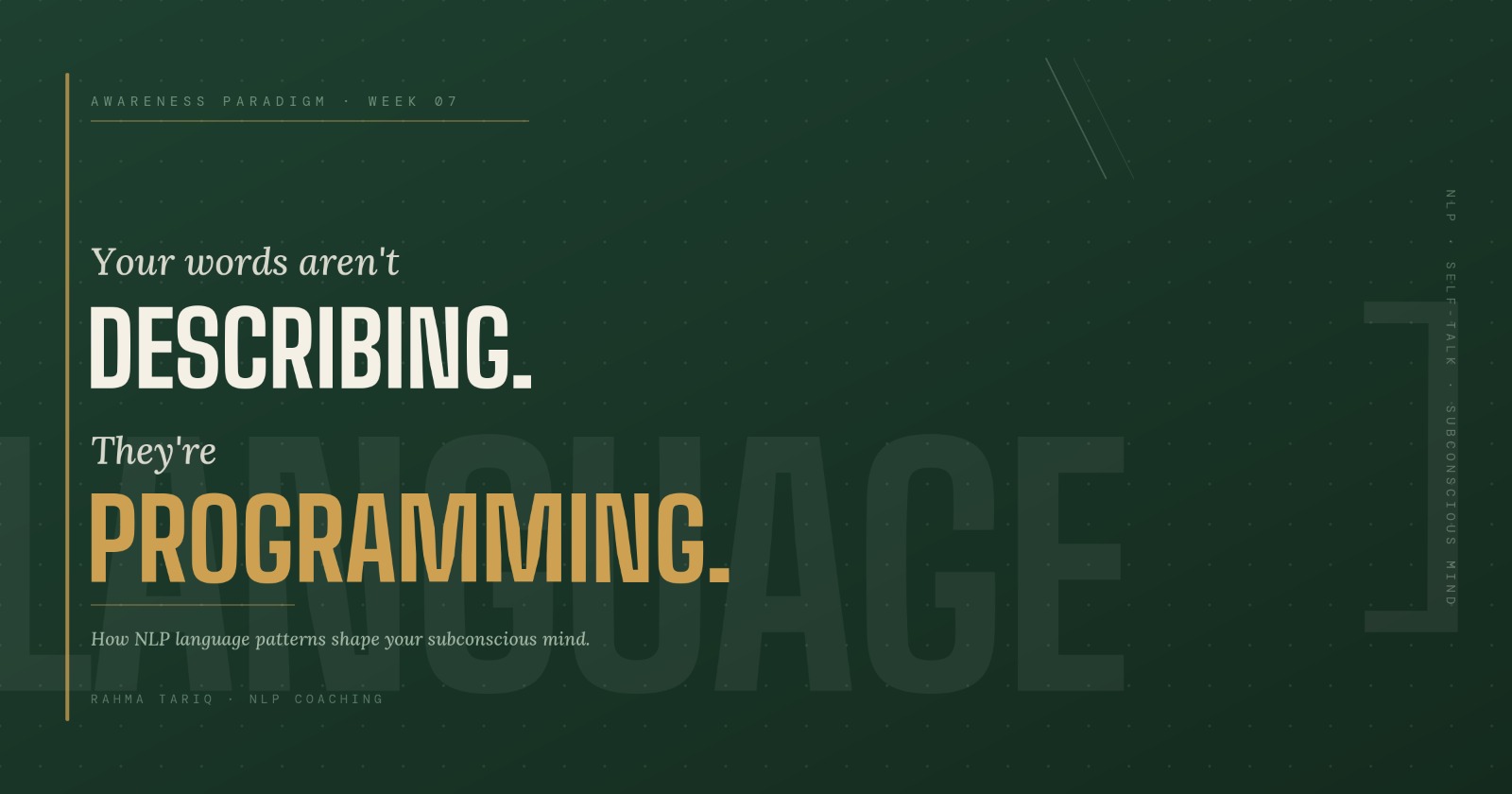
That is what NLP -- neuro-linguistic programming -- is actually about. Not clever techniques or scripts to use on other people. It is about understanding the relationship between language and the subconscious mind. How the words you use, especially the ones you say to yourself, are not just describing your life. They are creating it.
What the Subconscious Mind Actually Does With Your Words
Your subconscious mind is not a critic. It is not checking whether what you say is fair or accurate.
It is a filing system.
You give it a sentence. It files it. It acts on it.
When you say "I'm so stupid," your brain doesn't add a footnote: she's just frustrated right now, ignore this. It logs: I am stupid. When you say "this always happens to me," your brain doesn't hear: this happened twice this week. It hears: this is a permanent pattern in my life.
The subconscious mind takes your self-talk at face value. No edits. No context.
This is why NLP language patterns matter so much. The words you use most often, especially the ones you use automatically, are the words your subconscious mind is building your reality around.
And most of us are using words we never consciously chose.
The Five NLP Language Patterns That Hold People Back Most
These are the patterns I see most often in coaching. They feel like honesty. They function like limitations.
"I always" and "I never." These are called universal quantifiers in neuro-linguistic programming. One moment gets stretched across all of time. "I never finish what I start." "I always say the wrong thing." Your brain hears this and starts collecting evidence. It finds examples that fit. It ignores the ones that don't. Within a short time, the universal feels like a fact, because the mind made it one.
"I can't." Usually this is not about ability. It is about belief, or fear, or a decision made in the past. "I can't speak up." "I can't stick to anything." The word "can't" closes the door before the mind even looks for a way through. In NLP coaching, this is one of the first patterns we look at, because it has often been running the longest.
"I'm just..." This one is quiet. "I'm just not that kind of person." "I'm just not good at this." The word "just" does a very specific thing: it makes the limitation sound humble and fixed at the same time. Like you're being honest rather than small. But your subconscious mind receives it as instruction: don't bother trying.
"I should." When everything in your life is a "should," the brain starts to register your whole existence as pressure. Not choice. Pressure. This produces resentment, resistance, and a low-level feeling of being trapped even when things are technically fine.
"That's just how I am." This is the full stop at the end of all growth. Five words that declare the investigation finished before it began.
Why You Use These NLP Language Patterns Without Realising
You didn't create these patterns on purpose.
You absorbed them.
The way you talk to yourself is largely a reflection of how you were talked to as a child, or how you learned to talk to yourself in order to survive a particular environment. A child who grew up around criticism learns to criticise themselves first. A child in an unpredictable home learns to use absolute language because "always" and "never" feel more stable than uncertainty.
These were adaptations. They made sense once.
The problem is that you carried them into adulthood, and now they are running in the background of your life like old software. Your self-talk keeps producing the same outputs. Your subconscious mind keeps building the same case. And the outcomes keep looking the same.
The Quran says: "Verily, Allah will not change the condition of a people until they change what is within themselves." (Ar-Ra'd: 11)
I used to read this as a spiritual principle. And it is. But it is also a practical one. Real change does not start with new habits or new goals. It starts inside. In the words. In the language patterns that have been running in the background, shaping everything, long before any strategy arrives.
What Changes When You Change the Language
This is the part that surprised me the most when I began studying NLP.
You don't need to believe the new words immediately. You just need to say them.
The subconscious mind responds to repetition, not sincerity. New language patterns, repeated consistently, begin to build new pathways in the brain. New pathways produce new defaults. Eventually, the new words start to feel true, because the mind has built a new case around them.
This is not affirmation culture. It is not toxic positivity.
It is how language and the brain actually work, and NLP is built on that foundation.
The shift starts with noticing. You cannot change a pattern you cannot see.
Five Practical Ways to Start Rewiring Your Self-Talk
- Audit your universals. For one day, write down every time you use "always" or "never" about yourself. Then ask: is this genuinely true in every single case? Your brain is building a case on your words. Give it more accurate words to work with.
- Change "can't" to "haven't yet" or "I'm choosing not to." "I can't be consistent" becomes "I haven't found my consistency yet." The door stays open. The subconscious mind keeps looking. That one word does a significant amount of work.
- Drop "I'm just." Every time you catch it, finish the sentence without it. "I'm just not a morning person" becomes "I'm not a morning person yet." Or: "Mornings are hard for me right now." Both are more honest than a fixed identity.
- Swap "should" for "want" or "choose." "I should exercise" becomes "I want to feel stronger" or "I'm choosing to move today." This moves the brain from obligation to agency. Agency produces action far more reliably than pressure does.
- Challenge "that's just how I am." Don't replace it immediately. Question it first. When did you decide this? What experience taught you this was permanent? Most of the time, this is a conclusion that was reached in a specific moment, in a specific season of life, that has since been repeated so many times it started to feel like biology.
It is not biology. It is a language pattern. And language patterns can change.
The Self-Talk Nobody Sees
The most powerful words you use are not the ones you say out loud.
They are the ones you say to yourself in the quiet. In the space between something happening and how you frame it. In the moment after a mistake, before anyone else has even noticed.
That internal dialogue is shaping you more continuously, and more powerfully, than most external circumstances ever will. Most people spend years trying to change their outcomes while leaving the inner language running on the same old code.
NLP coaching is, at its most essential, the work of reading that code. Seeing the patterns. Questioning which ones you would actually choose, if you were choosing.
Because you are the one speaking.
And the subconscious mind is always listening.
If the patterns in this post feel familiar and you are ready to look at them more closely, the Our Plans page has coaching options built for exactly this -- NLP and mindset work that goes beneath the surface, from the Base Plan all the way to the Pro.